

On 18 June 2026, OSTrails hosted the webinar "Interoperability Frameworks in Practice: From Node Experience to Adoption in the EOSC Federation", bringing together over 50 participants, including representatives from national and thematic (candidate) nodes of the EOSC Federation, research infrastructures, and the wider Open Science community.
The webinar provided a practical look into how the OSTrails Interoperability Frameworks (IFs), Data Management Plans-IF (DMP-IF), Scientific Knowledge Graphs-IF (SKG-IF), and FAIR-IF, are being implemented across Europe through national and thematic pilots. The session demonstrated that adopting these frameworks is both feasible and achievable with a low barrier to entry, with the potential to strengthen interoperability in research data management within the emerging EOSC Federation.
From Interoperability Concepts to Practical Implementation
Opening the webinar, Tomasz Miksa (TU Wien) introduced the OSTrails architecture and the three interoperability frameworks and explained how they address key aspects of the research lifecycle:
- DMP-IF enables machine-actionable DMPs (maDMPs) that can seamlessly exchange information with other research services.
- SKG-IF provides a common framework for connecting SKGs, allowing research outputs, datasets, software, projects, instruments, and researchers to become part of an interoperable scholarly ecosystem.
- FAIR-IF establishes an approach to FAIR assessment, promoting transparent, evidence-based evaluation of FAIRness of data and other resources across communities.
Rather than targeting researchers directly, the frameworks are designed to support service providers, software developers and infrastructure operators by reducing integration costs, enabling automation, and avoiding vendor lock-in. Several speakers highlighted interoperability as a factor that could potentially support more efficient research workflows.
Further information is available in the OSTrails project documentation that can be accessed through this link: OSTrails Documentation
National Pilots Showcase Real-World Adoption
A central part of the webinar featured experiences from three national pilots that are actively integrating the OSTrails Interoperability Frameworks into their national research infrastructures.
Finnish Node
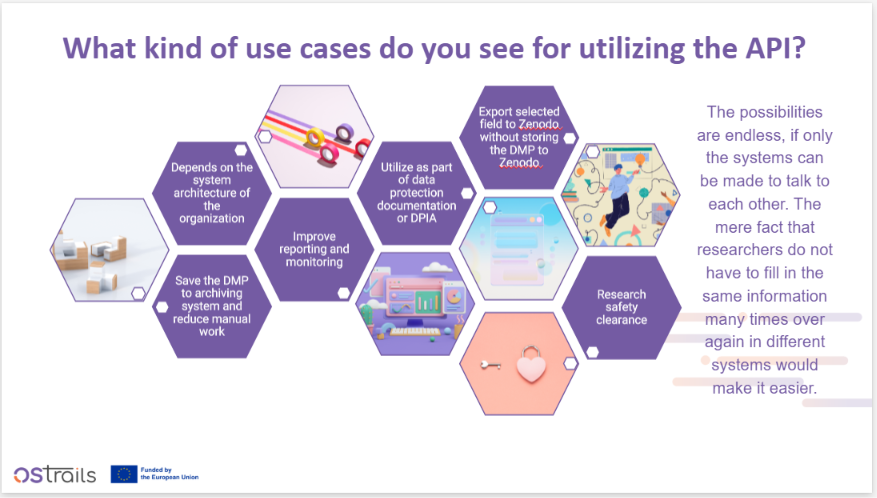
Johanna Laiho-Kauranne (CSC) presented Finland’s pilot on developing a scalable, machine-actionable DMP metadata model aligned with both the RDA standard and the OSTrails DMP-IF. The pilot aims to develop a single reference data model for maDMPs that is expected to be adopted by at least 60 organisations in Finland. Developed in collaboration with more than 20 organisations and numerous national stakeholders, the model demonstrates how national requirements can be addressed while remaining fully compatible with European interoperability efforts. The pilot presentation also highlighted the importance of persistent identifiers, machine-readable metadata, software management planning, and API-based integration across research services.
Polish Node
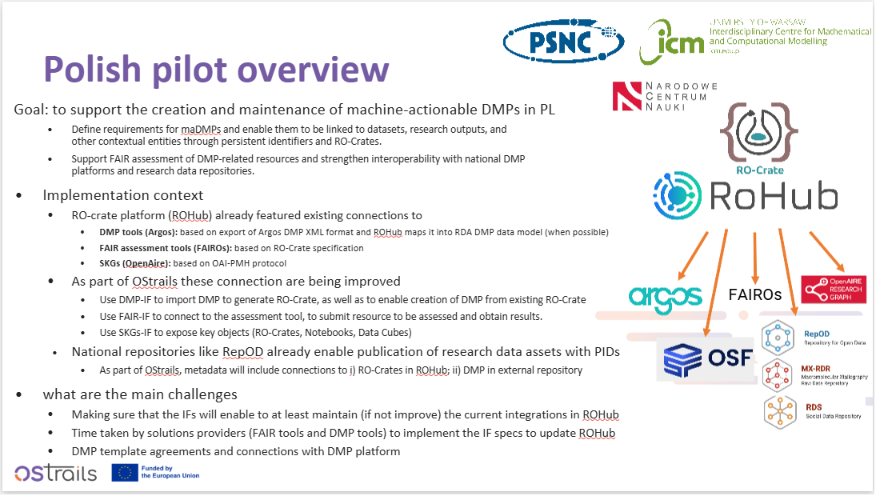
Raul Palma (PSNC) showcased how the Polish pilot integrates the three OSTrails interoperability frameworks through the national research infrastructures. By connecting machine-actionable DMPs, FAIR assessment services, SKGs and national repositories, the pilot demonstrates how interoperable services can support both national infrastructure and future EOSC Federation services. The adoption of common APIs demonstrates how interoperability can be practically implemented and is reducing the complexity of integrating diverse research tools.
Dutch Node
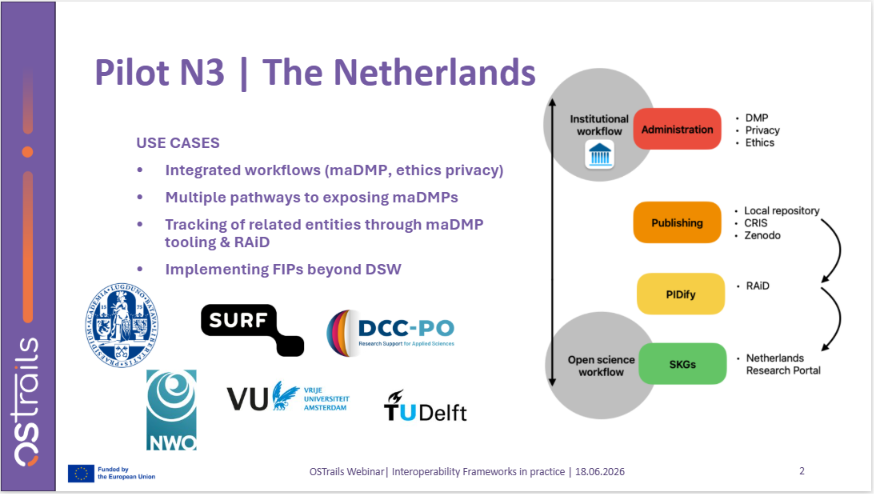
Eileen Waegemaekers (SURF) presented the Dutch pilot, which focusses on integrating research workflows across institutions in the Netherlands. The work presented explores how maDMPs can support compliance processes, improve discoverability through Scientific Knowledge Graphs, and enable reproducible research workflows by connecting services across the Dutch EOSC Node.
A key aspect of the pilot is reproducibility as a workflow: the use of maDMPs enables end-to-end workflow coordination, while SKG-IF supports tracking research from outputs to research processes, connecting related entities across the scholarly ecosystem. The use cases presented demonstrated the integration of maDMPs and how related entities are tracked through maDMP-driven workflows.
Thematic Pilots Demonstrate Domain-Specific Benefits
The webinar also featured some thematic pilots that illustrate how the interoperability frameworks can support domain-specific research communities: (i) PaNOSC, and (ii) CLARIN and SSH at large. The PaNOSC pilot presentation demonstrates how persistent identifiers, maDMPs, SKGs and FAIR assessment can be integrated into experimental research workflows, enabling stronger links between datasets, instruments, publications and research infrastructures.
You can see the full presentation of this pilot here: OSTrails – Thematic Pilot PaNOSC - Photon and Neutron Open Science Cloud - Presentation | Zenodo
The focus of the thematic pilot conducted by CLARIN is focusing onmaking metadata accessible to machines. The CLARIN research infrastructure for language resources is already offering metadata from a network of distributed repositories to human users via the Virtual Language Observatory (VLO). The SKG-IF adds machine access to the metadata harvested by the VLO via a common API shared across multiple research infrastructure nodes, thus strengthening interoperability within the EOSC Federation. In addition, the pilot focuses on how the FAIR-IF can be incorporated into the workflow of CLARIN nodes by reporting the FAIRness of datasetsand providing guidance for improvement where applicable. The pilot also covers how the DMP-IF supports projects in anticipating and monitoring compliance with CLARIN requirements.
In Summary
Together, the national and thematic pilots demonstrate that the OSTrails Interoperability Frameworks are sufficiently flexible to address diverse disciplinary requirements while maintaining a common approach to interoperability.
Key Messages from the Discussion
The interactive Q&A session generated valuable discussion around the future adoption of the interoperability frameworks within the EOSC Federation.
One of the key messages was the growing interest from (candidate) EOSC Federation nodes. Several participants expressed an interest to further explore how the OSTrails Interoperability Frameworks could be integrated into their own infrastructures and highlighted the importance of continued dialogue with the OSTrails team to address node-specific implementation needs.
Participants also noted that quantitative evidence demonstrating how the frameworks improve the quality of Data Management Plans would be particularly valuable in supporting wider adoption.
Anca Hienola (ENVRI Community) highlighted the strategic importance of SKGs, emphasising that their true value lies in connecting datasets, publications, software, researchers and other scholarly resources into an interoperable research ecosystem. The discussion also underlined the role of FAIR assessment tools in providing evidence of FAIRness through higher-quality metadata and machine-actionable information.
Responding to these points, Tomasz Miksa, Technical Coordinator of OSTrails, highlighted that OSTrails is committed to supporting EOSC Federation nodes with practical implementation guidance while ensuring the long-term sustainability of the interoperability frameworks.
Paolo Manghi, CTO of OpenAIRE, further observed that the OSTrails Interoperability Frameworks represent a strategic step towards building a shared vision of interoperability across research infrastructures and the EOSC Federation.
Looking Ahead
The webinar confirmed that interoperability is no longer simply a conceptual objective; it is becoming an operational reality.
The experiences shared by the pilot teams demonstrated that the OSTrails Interoperability Frameworks can be adopted incrementally, allowing organisations to modernise existing services without necessarily requiring major changes to their infrastructural set-up. This practical, standards-based approach positions the frameworks as valuable building blocks for the EOSC Federation.
As a next step, the OSTrails pilot teams will engage directly with interested national and thematic EOSC Federation nodes to better understand their specific requirements and explore how tailored support can facilitate future adoption.
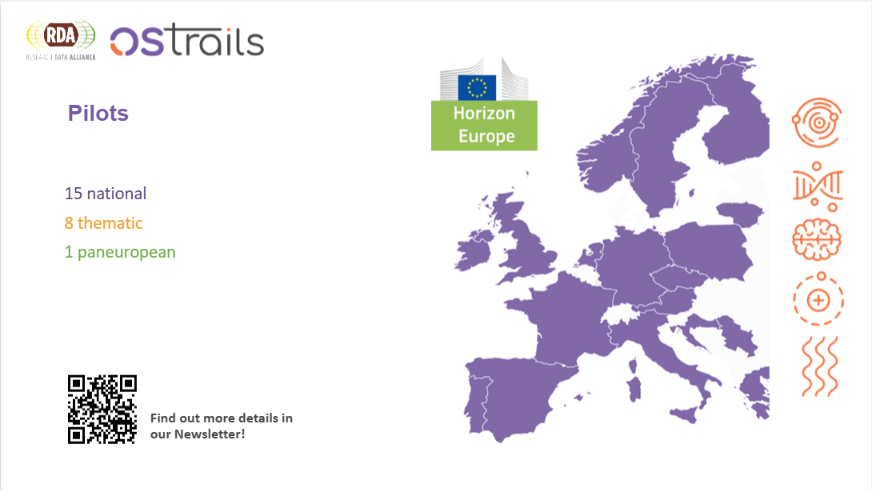
The knowledge generated through all 23 OSTrails pilot studies will be consolidated in the upcoming project deliverables D4.3 and D4.4, that will document the findings and provide guidance to support the implementation of interoperable research data management services across Europe.


