

Read the Interview with the Thematic Pilot for Biodiversity to discover the latest updates on OSTrails pilot studies. Explore pilots progress in integrating open science principles and advancing research assessment. This month we had the pleasure of speaking with Joaquín López Lerida (LifeWatch ERIC Data e-Science) and Christos Arvanitidis (LifeWatch ERIC).
 |
 |
| Christos Arvanitidis | Joaquín López Lerida |
"OSTrailsprovides a unique opportunity to align LifeWatch ERIC’s biodiversity data infrastructure with emerging European standards for FAIRness, interoperability and machine-actionable DMPs. By integrating the OSTrails tools and frameworks into theour SKG-driven approach, greater visibility, traceability, and reuse of research outputs can be offered to the environmental sciences."
Can you briefly introduce your organisation(s)? How does it/do they contribute to EOSC?
LifeWatch ERIC is the European Research Infrastructure Consortium dedicated to biodiversity and ecosystem research. It contributes to EOSC through the development and provision of Virtual Research Environments (VREs), semantic tools, and data services that support open science, reproducibility, and cross-disciplinary collaboration. Our participation in EOSC focuses on enabling FAIR access to environmental data and analytical workflow
What are you most excited about in OSTrails? What are you looking forward to?
OSTrails offers a practical framework to link together Scientific Knowledge Graphs (SKGs), Data Management Plans (DMPs) and FAIR assessments in a unified, API-driven ecosystem. We're particularly excited about the opportunity to integrate LifeBlock, our biodiversity knowledge graph, with the DMP-IF and FAIR-IF pathways. This allows us to embed FAIRness into the research process itself, not just evaluate it post-hoc.
How is planning, tracking and assessing research being realised in your country/scientific domain?
In biodiversity and ecosystem research, there is growing awareness of the need for machine-actionable planning and transparent metadata practices. However, adoption is still fragmented. Projects such as OSTrails and infrastructures such as LifeWatch ERIC, are contributing to the development of community-aligned machine-actionable Data Management Plans (maDMPs), semantic annotation, and dataset-level FAIR assessments that can scale across European initiatives such as EOSC.
Can you provide some details on your pilot's main actors, services and priorities? How will your pilot adopt the results of OSTrails?
The LifeWatch ERIC focuses on:
- Enrich the LifeBlock SKG with real-world datasets (e.g., from MARBEFES)
- Implement a maDMP template, to be deployed via ARGOS (https://argos.openaire.eu/)
- Link SKG entities to digital objects (DOs) with qualified references (QRs)
- Developing a real graphical environment for showing and reference SKG
- Applying FAIR assessment tools developed by WP3
LifeWatch aims to adopt OSTrails results by aligning with the SKG-IF, DMP-IF and FAIR IF (https://docs.ostrails.eu/en/update-restructure/architecture/intro.html), thereby ensuring that LifeWatch ERIC services remain interoperable, standards-compliant, and machine-readable.
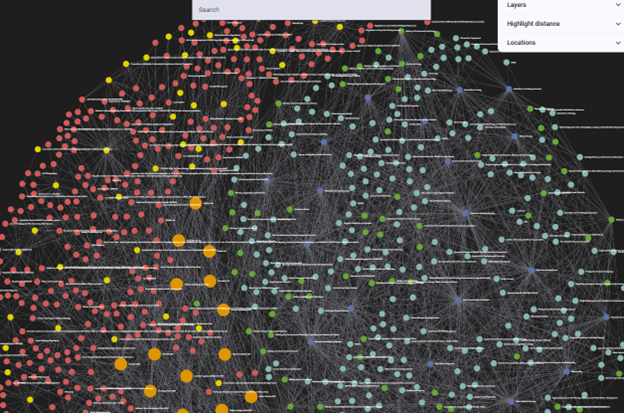
SKG tool which is being developed by LifeWatch ERIC
Ongoing activities and Next Steps?
LifeWatch has:
- Completed a first maDMP draft (uploaded to ARGOS)
- Designed the semantic structure of the LifeBlock SKG, based on previous tools (e.g. HGyOG)
- Selected pilot datasets from the MARBEFES project
- Begun mapping our metadata to SKG-IF and preparing FAIR assessment metrics
Next steps include:
- Uploading the maDMP and testing API interactions
- Deploying the LifeBlock SKG front-end
- Running first-round FAIR assessments
- Providing feedback to WP1–3 to help refine metrics and interoperability models


