

We came back from Nice with a clear sense that OSTrails is hitting the right notes. The third edition of the EOSC Winter School (27–29 January) brought together over 170 participants from across the EOSC community, and for the OSTrails representatives it was the perfect setting to test whether our Interoperability Frameworks resonate with the people who would need to use them.
Hint: They do!
The brokerage event changed how we talk about OSTrails
The EOSC Stakeholder Brokerage Event on 27 January was structured as a matchmaking session: 10-minute meetings with EOSC Node representatives, one table per Node. The new 3fold OSTrails leaflet was prepared specifically for this event, which made all the difference. Instead of launching into explanations about what DMP-IF, SKG-IF, and FAIR-IF are supposed to do, we could hand people something, point to specific parts, and have an actual conversation.
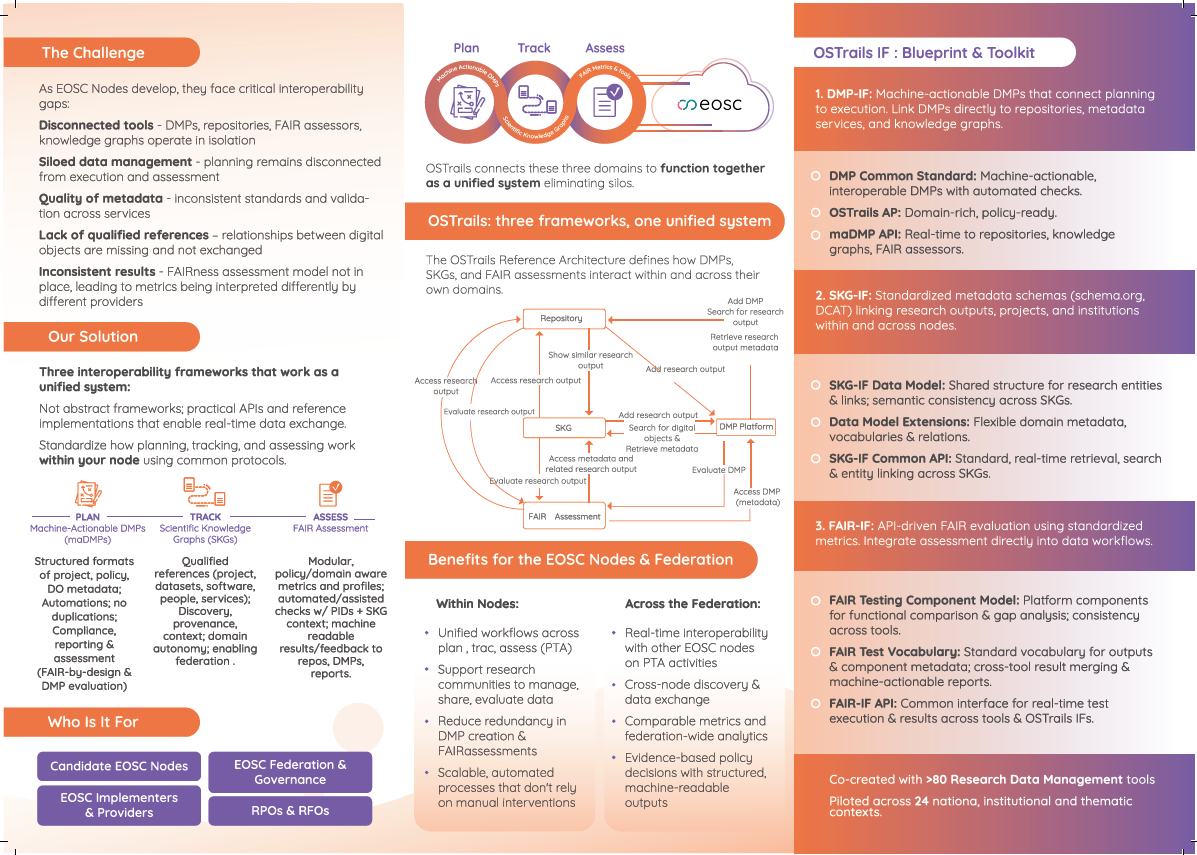
Striking was the diversity of where different Nodes are in their journey, and how OSTrails speaks to each of them differently:
| Slovakia is just starting to build their national repository networks. They wanted to know how to get things right from the beginning; how to avoid the silos that more established systems are now trying to untangle. Our DMP-IF work on machine-actionable DMPs and the idea of connecting planning to discovery via SKGs really clicked for them. |
| Italy came with specific questions about SKG federation. They're working on linking Scientific Knowledge Graphs across institutions and were keen to dig into our metadata schemas and APIs. This was a more technical conversation, which we appreciated. |
| EUDAT focused on maDMPs: how to make Data Management Plans actually do something rather than sit in a drawer. The maDMP API and what we're developing around real-time connections to repositories was exactly what they wanted to explore further. |
| The Polish node is already benefiting from discussions on how to align the national funder template with machine‑actionable DMPs that are part of the DMP‑IF created by OSTrails. Although the Polish node does not yet offer any services related to DMPs, its large network of universities is already analysing the work of OSTrails to make the best possible use of the federation and the interoperability across different DMP tools. |
| The Polish node is already benefiting from discussions on how to align the national funder template with machine‑actionable DMPs that are part of the DMP‑IF created by OSTrails. Although the Polish node does not yet offer any services related to DMPs, its large network of universities is already analysing the work of OSTrails to make the best possible use of the federation and the interoperability across different DMP tools. |
| Health Data Space representatives zeroed in on FAIR-IF. For health data, assessment isn't optional, it's about compliance, quality assurance, and trust. The modular, provenance-aware approach we're taking fits well with their regulatory requirements. |
Breakout sessions: presenting, learning, and pushing back
| The OSTrails presence at the Winter School was guided by a clear objective: to position the OSTrails Interoperability Frameworks as a federation capability that EOSC Nodes can adopt. |
DMP-IF, SKG-IF, and FAIR-IF were co-created with input from over 80 research data management tools and are being tested across 24 pilots in national, institutional, and thematic contexts. OSTrails participated in the Winterschool to make the case that these frameworks belong in the Federation's toolkit, and to offer our ongoing collaboration with the Task Forces on Semantic Interoperability and FAIR Metrics & Digital Objects to help make that happen.
OSTrails contributed to the thematic track sessions 1 and 3 to strengthen the understanding of the community needs, and where OSTrails might need to adjust.
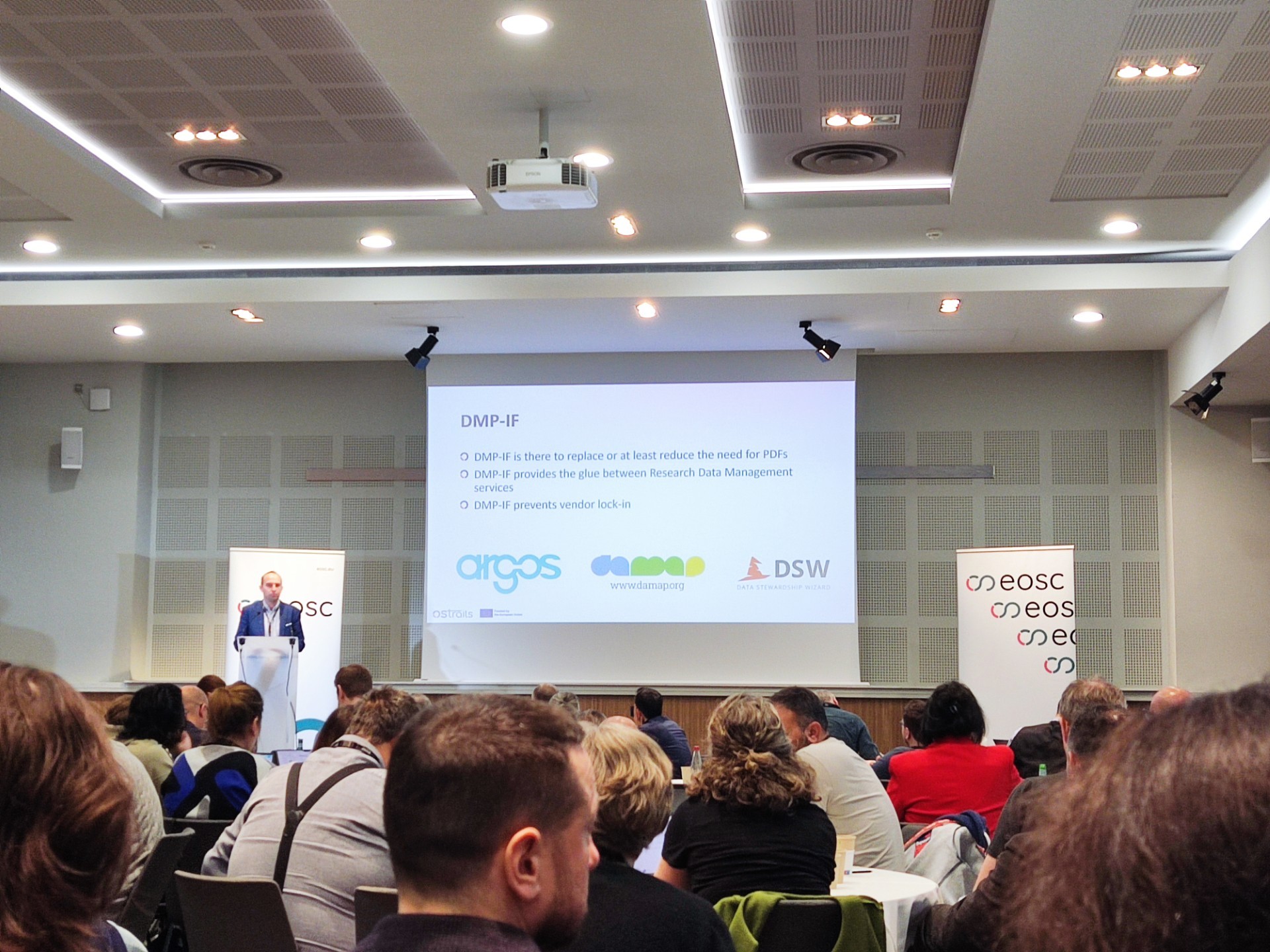
Tomasz Miksa (Technische Universität Wien) presented the DMP‑IF in a lightning talk during Thematic Track 1, Session A. He focused on concrete examples demonstrating how the DMP‑IF can create value, highlighting three key points:
- DMP‑IF replaces—or at least reduces the need for—PDF-based data management plans.
- DMP‑IF acts as the “glue” between Research Data Management services.
- DMP‑IF helps prevent vendor lock‑in.
- He concluded his presentation by inviting the audience to suggest additional useful interactions that could support automation in Research Data Management, beyond those already identified by OSTrails. We still hope to receive this feedback—including from readers of this post.
Tomasz Miksa and Esteban González Guardia (Universidad Politécnica de Madrid) also chaired Session B of Track 1, which was organised in a World Café format. This was the session with the highest participation in the entire Winter School, which made it particularly challenging to facilitate.
The format encouraged participants to learn from one another. Given the scale of the discussions and the broad distribution of topics, it was not feasible to define a concrete set of follow‑up actions—nor was this the intention. The purpose of the session was to stimulate exchange, and in that regard, it fully met its goal.
We also came with questions: things we've been running into in our pilots that don't have clear answers yet.
On FIPs (FAIR Implementation Profiles), this has been a longer conversation for us. Some of our pilots wanted to use FIPs, but we quickly ran into obstacles: they can't really be used outside the community they were designed for. The tooling, the assumptions, the ecosystem is very controlled and tied to one provider. We organised a meeting to try and find a way forward, which eventually led to the Dutch pilot taking this on. They are now producing a deliverable examining whether and how others can use FIPs, laying out the challenges and limitations honestly, and pointing to possible paths forward.
But there's a broader point here for us. OSTrails challenges the premise of FIPs to some extent: the information that FIPs capture is largely information we already have in Scientific Knowledge Graphs. So in our architecture, we position FIPs as components within the FAIR-IF—part of the assessment layer—rather than as a standalone solution. This reframing matters because it affects how communities should think about implementing FAIR: not as a parallel process, but as something integrated with how they already track and describe their research outputs.
These are ongoing discussions, and the Winter School was a good space to work through them together with the rest of the EOSC community.
One thing that keeps coming up, and came up again in Nice: everyone's situation is different, and it was good to hear it directly from Node representatives too. What works for a well-established national infrastructure won't work for a thematic community just getting organised. Our frameworks need to be modular enough to meet people where they are, and based on the feedback, we're on the right track.
What worked well
A small thing, but worth mentioning: having a physical leaflet to hand over changed how people engaged with us. They could flip through it, mark things, and take it back to their teams. It sounds obvious, but when you're explaining something as layered as three interconnected interoperability frameworks, having something tangible helps. We saw people walking around with it, showing it to colleagues. That's the kind of reach you don't get from a slide deck.
|
What's next We're following up with several Nodes on mentorship, component testing, and roadmap alignment. The appetite is there; our job now is to make adoption easy. |


